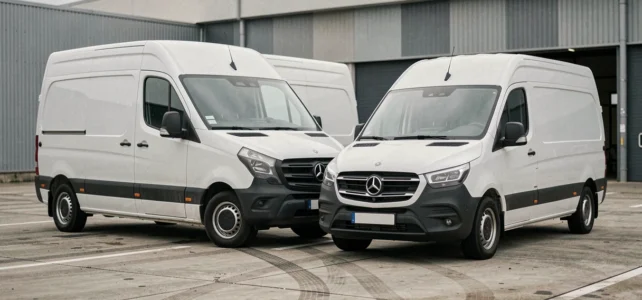
The designations H2 and H3 refer to the height of a van’s roof. H2 corresponds to a raised roof, while H3 refers to a very high roof. The difference in interior height between the two is generally between 20 and 30 centimeters, but these centimeters affect the usable volume, traffic constraints, and the operating cost of the vehicle.
Toll class and overall height: the hidden cost of the H3 van
Comparisons between H2 and H3 vans often address volume and comfort, but less frequently the toll aspect. In France, the toll classification on highways is partly based on the height of the vehicle. Most H2 vans remain in class 2 (vehicles between 2 and 3 m high, with a maximum authorized weight of 3.5 tons).
An H3 van, once equipped with roof accessories (roof rack, solar panel, antenna), can exceed the 3 m threshold and shift to class 3 at tolls. The additional cost applies to each barrier crossing across the entire highway network. Over a year of regular travel, the budget difference becomes significant.
Before choosing an H3, the measurement to take is the actual overall height, including mounted equipment. A detailed comparison of H2 and H3 vans allows for a confrontation of the exact dimensions according to the chassis and configurations.

Usable interior height: what an H3 van really gains
The interior loading height of an H2 is around 1.90 m to 2.00 m depending on the chassis. An H3, like the Mercedes Sprinter in L3H3 or L4H3 configurations, offers about 2.24 m of loading height. These additional centimeters open up two specific technical possibilities.
False floor and technical networks
A false floor of 15 to 20 cm thick allows for the housing of water tanks, electrical cable passages, and heating ducts. In an H2, this false floor reduces the remaining height under the ceiling to less than 1.80 m, making standing uncomfortable for most adults.
The H3 allows for a technical false floor without sacrificing living height. For a travel van layout with a bathroom, shower, or high kitchen, this margin changes the design of the space.
High storage
In an H3, upper storage (high cabinets, overhead lockers) does not encroach on the circulation area. In an H2, every centimeter of high storage compresses the perceived living space.
Access restrictions: parking, height barriers, and urban templates
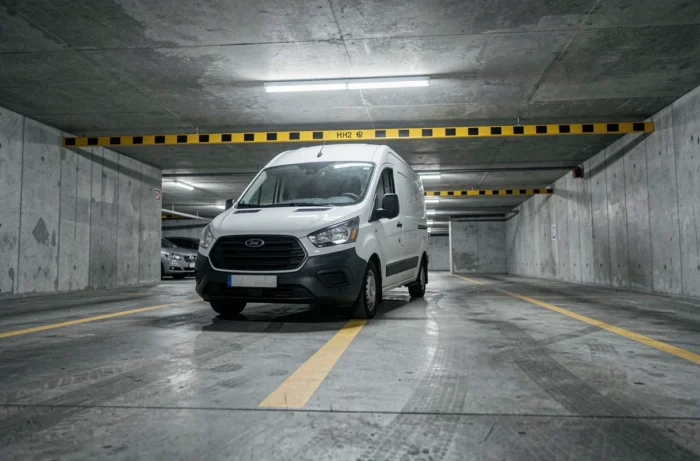
The overall height of an H2 van already exceeds 2.50 m. An H3 commonly reaches between 2.80 and 2.90 m. These dimensions exclude almost all underground parking, where height barriers are often set at 2.00 m or 2.10 m in city centers.
Height-limiting barriers installed in certain municipalities concern both H2 and H3 vans. The real difference lies elsewhere:
- Large covered parking sometimes accepts vehicles up to 2.40 m, which is still insufficient for both H2 and H3
- Some older structures (low bridges, rural tunnels) have limits between 2.50 m and 2.80 m, where the H2 can pass but not the H3
- Delivery areas in dense urban zones increasingly impose size restrictions, complicating the professional use of an H3 in city centers
For exclusively road or suburban use, the H3 does not pose particular difficulties. For city center rounds or daily parking in dense areas, the H2 offers more versatility.
Availability of the H3 according to chassis: an uneven offer
Not all manufacturers offer the H3 roof across their entire range. On the Mercedes Sprinter, for example, the H3 only exists in L3H3 and L4H3 configurations. Therefore, choosing a very high roof often requires accepting a long vehicle, which adds a maneuverability constraint.
The Fiat Ducato and Renault Master offer the H3 in more lengths, but the available combinations vary by model year and series. Checking the manufacturer’s catalog for the targeted year remains the only reliable method.
This limitation of the offer has a direct consequence on the used market: short or medium-length H3 vans are rare, which can extend search times or increase purchase prices.
What usage profile for each height of van
The choice between H2 and H3 is determined by crossing three concrete criteria:
- The main use: transport of bulky goods (H3 justified), travel van layout with false floor (H3 preferred), urban delivery or mixed use (H2 more suitable)
- The circulation territory: frequent highway network (check the toll class threshold), regular city centers (H2 less restrictive), rural roads and major routes (H3 without difficulty)
- The height of the driver and passengers: beyond 1.80 m, the H2 with a false floor becomes uncomfortable for living on board
The H3 does not always outperform the H2. A well-arranged H2 van, without a thick false floor, offers sufficient interior height for most professional layouts. The H3 gains an advantage whenever the layout requires overlapping technical levels beneath the living floor.
The toll cost, rarity in the used market, and size restrictions in the city are the three real drawbacks of the H3. They deserve to be quantified on a case-by-case basis before any purchasing decision.