
Charisma does not primarily rely on physical appearance or humor. A study published in 2024 in the British Journal of Social Psychology shows that initial popularity is more related to extraversion, particularly assertiveness and sociability. What concrete behaviors make a difference depending on the context, both in-person and via video? Here are ten measurable levers to enhance your attractiveness on a daily basis.
1. Calibrate your assertiveness without tipping into dominance
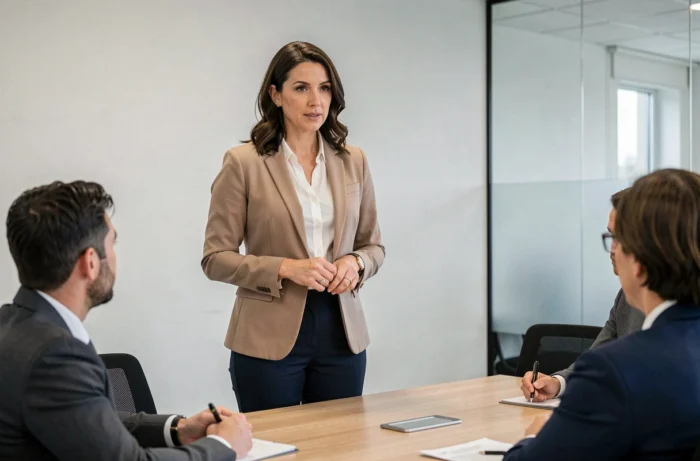
Assertiveness is the primary factor associated with popularity during encounters with strangers, according to the 2024 findings. It is distinguished from aggression by one specific point: expressing disagreement while validating the other person’s position.
Specifically, this involves phrasing like “I see things differently because…” rather than “no, you are wrong.” As detailed in articles from Fourchette et Mascara, natural charisma relies on this ability to take a stand without overpowering your interlocutor.
In group meetings, those perceived as the most charismatic are the ones who speak up early, articulate a clear idea, and then leave space for others. Measured assertiveness creates a signal of reliability that the group picks up within minutes.
2. Adapt your body language to the format of the exchange

Research from 2024 shows that charisma is expressed differently in person and in video conferencing. In face-to-face interactions, upright posture and open gestures are the dominant signals. Online, several channels count simultaneously: verbal, non-verbal, paraverbal, and overall presence on screen.
| Context | Dominant Signals | Common Pitfall |
|---|---|---|
| In-person | Upright posture, expansive gestures, body orientation | Too rapid gestures perceived as nervousness |
| Video conferencing | Camera gaze, modulated voice, visible facial expressions | Gaze fixed on the screen instead of the camera |
| Group of strangers | Early speaking, active sociability | Monopolizing speaking time |
This table summarizes an angle that most charisma guides overlook: the same behavior can enhance or weaken your attractiveness depending on the channel used.
3. Work on active sociability during collective tasks

Sociability, the second pillar identified by the 2024 study, is not just about “being nice.” It refers to the ability to initiate interactions and include silent individuals in a group exchange.
During a collective workshop or group interview, asking an open question to someone who hasn’t spoken yet produces a double effect. You show attention and create an alliance perceived by the entire group.
This behavior is particularly effective in professional contexts such as trade shows, seminars, or the first days in a new team, situations where initial popularity is determined in a matter of minutes.
4. Modulate your vocal pace to create anchor points

The paraverbal (tone, pace, volume) is a channel identified as significant in online interactions. Deliberately slowing down before a key piece of information forces the audience to concentrate.
A two-second pause before delivering an argument acts as an attention marker. Speakers perceived as charismatic do not speed up when they sense the group’s impatience: they maintain their pace, which reinforces the perception of mastery.
5. Use differentiated eye contact

Looking someone in the eye for three to five seconds before sweeping the group, then returning, creates an individualized connection within a collective. This triangular gaze pattern is one of the dominant gestures observed in people deemed popular in person.
In video, the camera gaze replaces this mechanism. Look at the camera when you speak, the screen when you listen: this simple alternation replicates natural eye contact.
6. Speak within the first thirty seconds

In group contexts with strangers, those who speak early are consistently perceived as more sociable and assertive. Waiting for “the right moment” to intervene is counterproductive: the group has already formed its initial impressions.
This does not mean monopolizing the exchange. A single sentence is enough: briefly introduce yourself, ask a question, or rephrase what has just been said. The first verbal signal anchors your presence in the group’s memory.
7. Physically orient your body towards the main interlocutor

Body orientation is a powerful non-verbal signal in person. Turning your shoulders and feet towards the speaking person conveys a message of consideration that words alone cannot produce.
Conversely, crossing your arms or orienting your torso towards the exit sends an immediate disengagement signal perceived by the group, even unconsciously.
8. Express structured disagreement rather than constant agreement

Agreeing with everything a group says does not generate charisma. Assertiveness, as measured in recent research, involves expressing personal positions. Those who articulate a divergent opinion in a structured manner (argument, example, opening) are perceived as more reliable.
The key is structure, not confrontation. Three elements are sufficient:
- Rephrase the other person’s position to show it has been heard
- Present your viewpoint by linking it to a fact or concrete observation
- Propose a synthesis or ask an open question
9. Reduce distracting gestures that muddle the message

Too rapid gestures, self-contact (touching your face, fiddling with a pen), and repetitive movements are perceived as signals of nervousness. In person, they diminish the impact of expansive gestures that, in contrast, enhance the perception of charisma.
A simple exercise: film a one-minute speaking segment and count the distracting gestures. Reducing these micro-movements visibly improves the readability of your non-verbal communication from the very first attempts.
10. Build coherence between verbal and non-verbal

Charisma is not a collection of isolated techniques. Recent research emphasizes that initial popularity results from a global coherence between what is said, how it is said, and what the body expresses. A confident speech accompanied by a closed posture creates a dissonance that the group detects immediately.
Working on a single channel (the verbal, for example) without aligning the others produces an artificial effect. Conversely, even a modest speech gains impact when the voice, gaze, and posture convey the same message.
The most underestimated factor in building charisma remains the context: in-person, video, or a group of strangers do not mobilize the same signals. Choosing your levers based on the situation yields faster results than applying a one-size-fits-all recipe to all interactions.