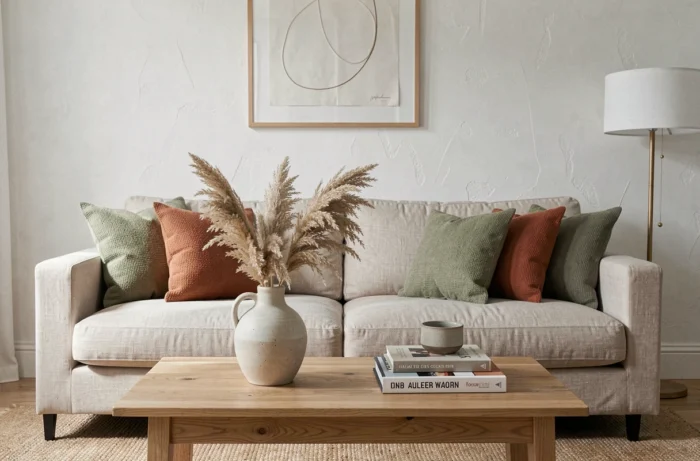
A repainted wall, a relocated light fixture, a changed textile: sometimes, three actions are enough to transform the perception of an entire room. Trendy decoration does not rely on a substantial budget, but on targeted choices that articulate color, light, and material. Here’s how to approach these choices without falling into the traps of “turnkey” interiors that are seen everywhere online.
Performative decoration and real comfort: the trap to avoid
Have you ever noticed that some interiors seen on Instagram or TikTok look stunning in photos, but are hardly livable on a daily basis? This phenomenon has a name: performative decoration. The idea is to arrange a space to be photogenic before it is functional.
The “bookshelf wealth” trend illustrates this disconnect well. It involves filling bookshelves with rarely read books, accumulated objects, and souvenirs arranged for the image. The result gives an impression of cultural wealth, but often generates an abundance of objects, increased maintenance, and functional incoherence in daily life.
Before reproducing an ambiance spotted online, ask yourself a simple question: will this room be pleasant to live in on a rainy Tuesday morning, without filters or studio lighting? If the answer is no, the inspiration deserves to be adapted. To explore decor ideas that prioritize comfort as much as aesthetics, you can visit the La Petite Déco website and browse their selections by room.
Natural colors and materials: the foundations of sustainable home decor
The choice of colors remains the most powerful lever for transforming an interior. But choosing a coherent palette matters more than following the color of the year. A trendy shade slapped on a wall without connection to the existing furniture creates a disjointed effect.
Building a palette from what you already own
Start with an element you don’t plan to change: a sofa, a floor, a kitchen countertop. Identify its dominant hue and its undertones (warm, cool, neutral). Then, choose a maximum of two complementary colors for the walls and textiles.
This method avoids buying “matching” decor accessories that end up homogenizing the space. It also helps reduce costly mistakes, as repainting an entire wall because sage green doesn’t work with your honey oak floor is a common disappointment.
Materials that transcend trends
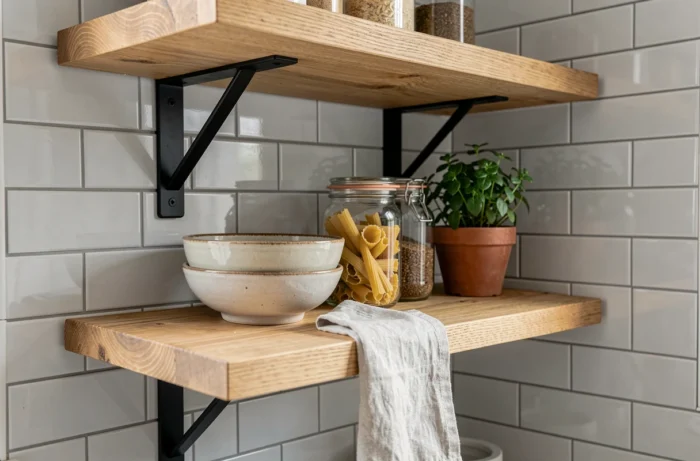
Linen, raw wood, terracotta, and rattan share a common point: they age well. Unlike very smooth finishes or shiny synthetic materials, natural materials gain character over time. A solid wood tray marked by use has more presence than a new laminate tray.
- Linen for curtains and cushions adds texture without visually weighing down the room and is easy to wash.
- Terracotta (pots, tiles, objects) introduces warm tones that work well in both a kitchen and a living room.
- Rattan or wicker, used sparingly (a chair, a pendant), lightens spaces without stripping them bare.
Lighting and staging: creating atmospheres by zone
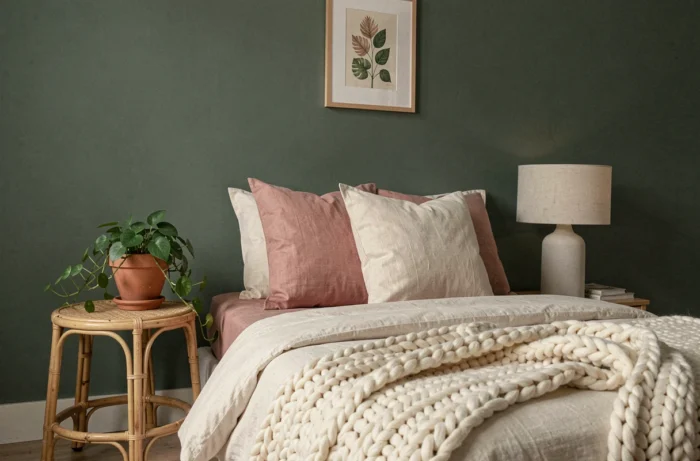
A central ceiling light that uniformly illuminates the entire room is the most common shortcut, and the least flattering. Light should be thought of in zones, not by room. A reading nook, a workspace, a dining table each call for a distinct source.
Layering three types of light
The rule is simple: combine general lighting (ceiling light or diffuse pendant), task lighting (desk lamp, under-cabinet spotlight), and ambient lighting (table lamp, discreet string lights, candle). This layering creates depth.
A living room lit only by a ceiling light appears flat. The same living room with a dimmed pendant above the coffee table, a reading lamp near the sofa, and a spotlight directed at a painting immediately gains relief and warmth.
Adapting color temperature to the room
Warm light bulbs (around 2,700 kelvins) are suitable for relaxation spaces: bedroom, living room. For a kitchen or office, a more neutral light improves visibility without causing fatigue. Mixing color temperatures in the same room creates visual discomfort that is felt without necessarily being identified.
Visible radiators and heating: a new style challenge
Competitors rarely talk about heating when discussing decoration. The evolution of energy standards changes the game. Recent reforms of the energy performance diagnosis (DPE) push homeowners to rethink their heat emitters, and this technical constraint becomes a full-fledged decor topic.
Rather than hiding a radiator behind a radiator cover (which reduces its efficiency), choosing a designer radiator or a radiant panel integrated into the wall allows you to transform a constraint into a decorative element. Some models present themselves as paintings or heated mirrors.
Hybrid stoves, which combine wood and pellets, combine energy performance with a strong visual presence in a living room or common area. The heating object becomes a focal point, just like a traditional fireplace.
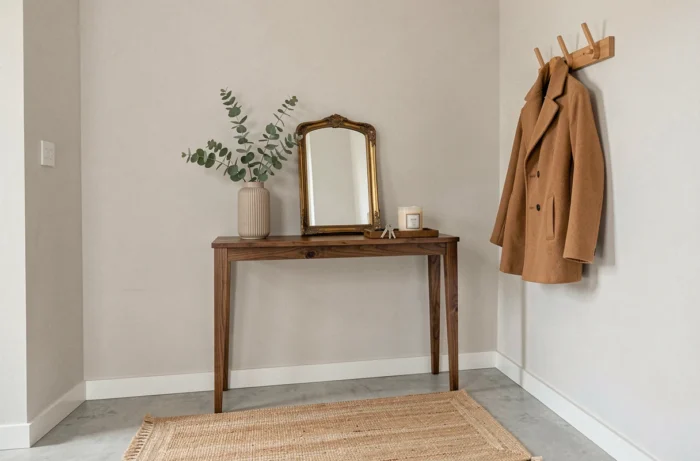
Enhancing your home with trendy decoration starts with resisting the urge to change everything at once. A wall repainted in a hue that is coherent with your furniture, two light sources added in the right places, a natural textile replacing a tired synthetic one: these three concrete actions have more impact than a complete makeover copied from an Instagram feed. The best decor is the one that works when no one is looking.