
The digital divide is no longer measured solely by the number of households connected to the Internet. In France, 34% of 16-74 year-olds lack basic digital skills according to INSEE, and 7% find themselves in a situation of complete illiteracy. Equipment is improving, connections are multiplying, but usage gaps persist, even widening between social categories, age groups, and territories.
Quality of fiber optics: the invisible digital divide
Discussions about Internet access focus on the deployment of fiber. Arcep, in the 8th edition of its Observatory of the Quality of Fiber Optic Networks (2026), points out a problem that coverage statistics mask: being connected does not guarantee a reliable connection.
In certain areas, connection faults (unexpected disconnections, continuity cuts, long repair times) effectively prevent teleworking, attending online courses, or accessing dematerialized public services. These households appear as “connected” in official reports. Their daily reality is one of intermittent connectivity.
This usage divide primarily affects rural and suburban areas, where, as reported by Votre Journal news, operators invest less in maintenance. The promise of universal Internet faces the technical reality of the last mile of fiber.

Illiteracy and digital skills: persistent figures
INSEE reminds us that one in six French people suffers from illiteracy. This term encompasses the inability to use basic digital tools: sending an email, filling out an online form, managing a password.
| Factor of inequality | Most affected population | Main consequence |
|---|---|---|
| Age | 70 years and older (lowest mobile equipment rate) | Exclusion from dematerialized administrative procedures |
| Level of education | People without a diploma or below the baccalaureate level | Difficulty in job searching, pursuing training |
| Income | Households below the poverty line | Lack of equipment or outdated equipment |
| Territory | Rural areas and isolated municipalities | Unstable connection despite theoretical connection |
The rate of home computer ownership increased from 23% to 78% between 1998 and 2018 according to Crédoc. Among executives and young people, access to technology approaches 100%. Disparities related to education and income persist, even as those related to age gradually diminish.
Equipment does not mean autonomy
Emmaüs Connect has equipped over 100,000 people in ten years with refurbished equipment and subsidized connections. The organization finds that providing a smartphone or computer is not enough: without support for basic skills, the equipment remains underutilized.
The distinction between “unequipped” and “poorly equipped” now structures the debate. Owning a smartphone does not protect against digital exclusion if one does not know how to create an account, navigate an administrative interface, or spot a phishing attempt.
Dematerialization of public services and social exclusion
Almost all administrative procedures are now conducted online. Tax declarations, registration with Pôle emploi, applications for social benefits: each procedure requires stable Internet access, a functional device, and a minimum level of technical proficiency.
For those in a situation of digital precariousness, this dematerialization produces a paradoxical effect. The tools intended to simplify access to rights become an additional obstacle. A train ticket, checking bus schedules, making a medical appointment: every daily action now requires managing multiple accounts and passwords.
The role of local authorities and associations
Local authorities are urging the state not to relax efforts on digital inclusion. Several initiatives exist:
- Digital workshops led by associations (Secours Catholique, Emmaüs Connect) offer individual support for online procedures, password management, and handling equipment
- Low-cost refurbished IT equipment allows modest households to be equipped without going through the new market
- Subsidized connections provide stable Internet access for households whose budget does not allow for a standard subscription
These initiatives remain fragmented. Their effectiveness depends on the territorial network and the ability of organizations to reach the most digitally distant populations.
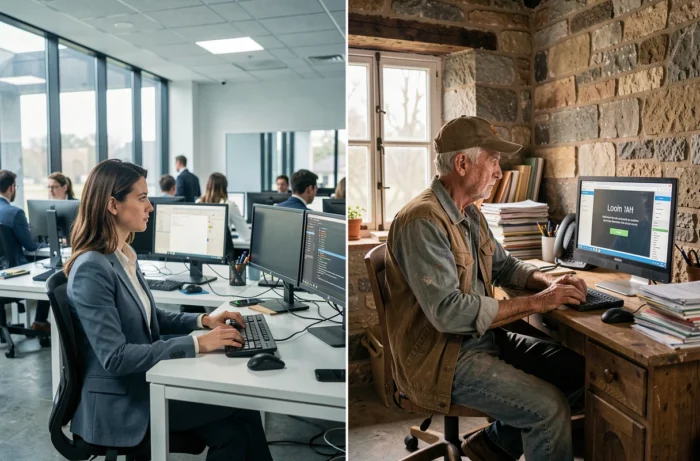
Digital accessibility: a legal obligation that changes the game
Digital accessibility is gradually becoming a requirement for companies, including SMEs. The European regulatory framework imposes design standards for websites and applications for people with disabilities.
Accessibility is not only about disability. Poorly designed interfaces also penalize the elderly, users unfamiliar with digital technology, and those using outdated equipment or slow connections. An administrative form that only works on the latest browser versions mechanically excludes part of the population.
In contrast, websites that comply with accessibility standards facilitate navigation for all user profiles. Designing for the most vulnerable improves the experience for all users.
The deployment of fiber, the distribution of equipment, and support workshops each address a facet of the problem. None of these levers work in isolation. The most revealing data remains this: more than a third of the French population does not master basic digital skills, in a country where almost all services are migrating online.