
The folding mechanism of the Trottine 55 relies on a classic two-stage cane system, with locking by a rear latch and side triggers. Here we detail the precise gestures, preliminary adjustments, and points of caution that the original manual briefly covers.
Lock the front swivel wheels before folding the Trottine 55
This is the action that most parents overlook, and it causes the majority of blockages. Locking the front wheels in a fixed position before folding aligns all four wheels on the same longitudinal axis. The chassis then descends straight down, without lateral twisting of the frame.
On the Trottine 55, the locking selector is located above each front wheel. Pressing down engages the fixed mode. We recommend making this reflex a habit, even on flat ground, as a free-swiveling wheel can deflect the connecting tube when the structure folds.
If you are looking to understand how to fold the Trottine 55 stroller correctly, this prior locking is the basic requirement.
Cane folding of the Trottine 55: step-by-step technical sequence
The cane folding (also known as “umbrella” folding) compresses the structure vertically by bringing the two handles closer together. On the Trottine 55, the sequence unfolds in three consecutive actions.
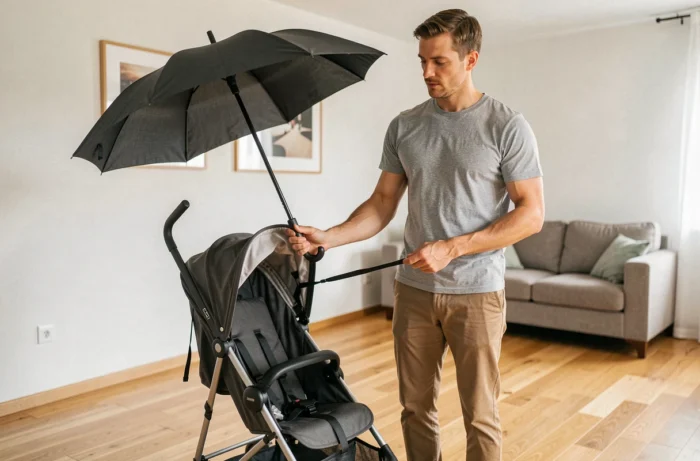
- Remove any accessories attached to the chassis (diaper bag, toys, poorly folded canopy). A residual load is enough to make the movement stiff, while the mechanism works perfectly when empty.
- Locate the two unlocking triggers located under the handles, at the junction between the upper tube and the connecting tube. Press them simultaneously inward.
- While keeping the triggers pressed, firmly push the handles down and forward. The stroller folds in on itself into a compact vertical position.
The rear latch, located in the middle of the frame, automatically engages at the end of the stroke to keep the stroller folded. Ensure that a clear click occurs. If the latch does not engage, the stroller may suddenly reopen during transport.
Never force the movement if resistance appears. In the vast majority of cases, a blockage indicates a stuck accessory or a front wheel that remains in swivel mode, not a mechanical defect.
Unfolding the Trottine 55 cane stroller: checkpoints
Unfolding is simpler than folding, but it has a common pitfall. On the Trottine 55, the procedure begins with releasing the rear latch.
Press the latch button (usually red or gray depending on the color) and spread the handles upward. The structure unfolds and the tubes lock in the open position with a second audible click.
The pitfall: not checking the locking of the side tubes. After unfolding, apply downward pressure on the seat, with the stroller empty. If the chassis sags or exhibits lateral play, the tubes are not engaged. Fold it back and repeat the action by pushing the handles all the way up.
Then switch the front wheels back to swivel mode if you want to regain maneuverability in the city. Forgetting this unlocking makes steering stiff, which can sometimes be mistaken for a wheel problem.
Diagnosis of recurring blockages on the Trottine 55
When folding becomes smooth when empty but jams during regular use, the problem lies with the load and not the mechanism. We observe three recurring situations with this model.
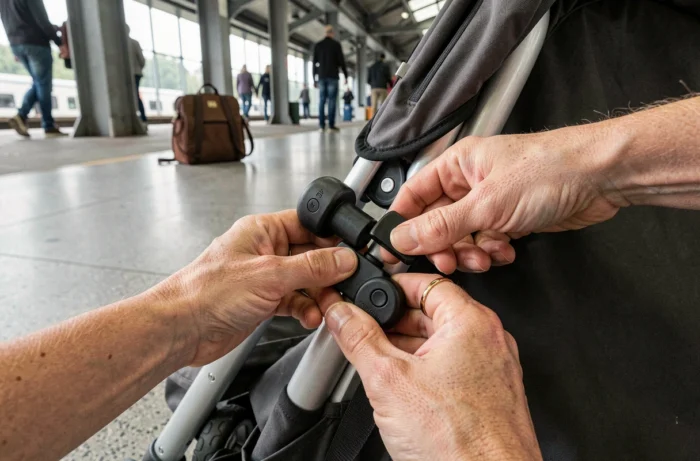
A poorly folded canopy is the most common cause. On the Trottine 55, the canopy folds back and then presses against the backrest. If it remains in an intermediate position, the fabric frame interferes with the connecting tube during descent.
The diaper bag hanging from the handles shifts the center of gravity upward and creates a torque during folding. Always remove the bag before folding eliminates this problem without further intervention.
The last case concerns dirty wheels. Sand or gravel lodged in the front wheel axle blocks rotation and, by extension, disrupts the alignment necessary for folding. A rinse with clear water on the axle, without greasy lubricant (which collects dust), restores normal operation.
Maintenance of the folding mechanism to extend its lifespan
The pivot points of the chassis undergo mechanical stress with each folding-unfolding cycle. On a cane stroller used daily, inspect the triggers and rear latch once a month to avoid unpleasant surprises.
Check that the triggers return to the out position after release. A tired spring manifests as a soft trigger that no longer pushes back your finger. In this case, replacing the spring is the only reliable solution.
The rear latch deserves the same attention. A clear click with each fold confirms that the hook engages properly. If the click disappears, a foreign object (crumb, sand) is preventing the hook from pivoting. A dry cotton swab is enough to clear the notch.
The Trottine 55 uses a lightweight tubular steel chassis. Avoid storing the folded stroller in a damp space for extended periods: oxidation of the pivot points gradually stiffens the mechanism. Dry storage, even in a ventilated car trunk, preserves the smoothness of the folding throughout the product’s lifespan.