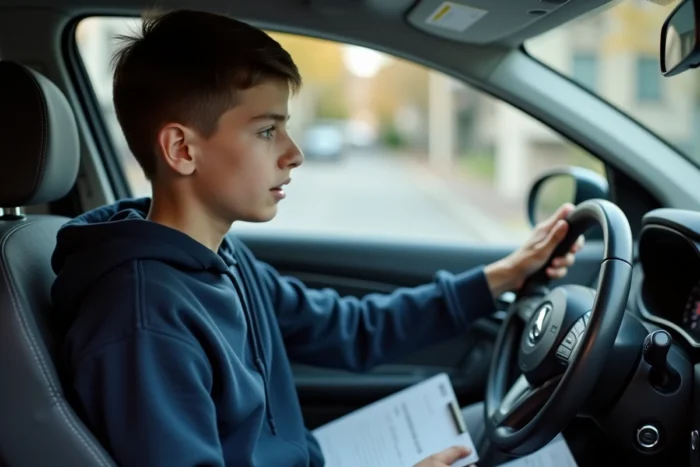
Since January 1, 2024, the minimum age to obtain a category B driving license has been lowered from 18 to 17 years in France. At 16 years old, driving a car alone remains prohibited. However, the regulatory framework allows for several steps to be initiated from this age, and even earlier, to expedite the path to the B license.
Theoretical road code test from 16 years: what the classic pathway allows
Most articles associate the age of 15 with the beginning of the journey, as they focus on accompanied driving (AAC). In reality, two timelines coexist depending on the chosen pathway.
In accompanied driving, registration for the code is open from 15 years old. In the classic pathway (traditional driving school training without an accompanying phase), the general theoretical test (ETG) can be taken from 16 years old.
In practical terms, a 16-year-old candidate who does not plan to pursue AAC can register with an accredited operator (La Poste, SGS ObjectifCode, Dekra, Code’nGo, Bureau Veritas), take the code exam, and have a result valid for five years. On their 17th birthday, they will only need to validate the practical test to obtain their B license.
In other words, at 16 years old, the possibility of taking the driving test at 16 years old translates into the early securing of the code, a considerable time gain on the overall journey.
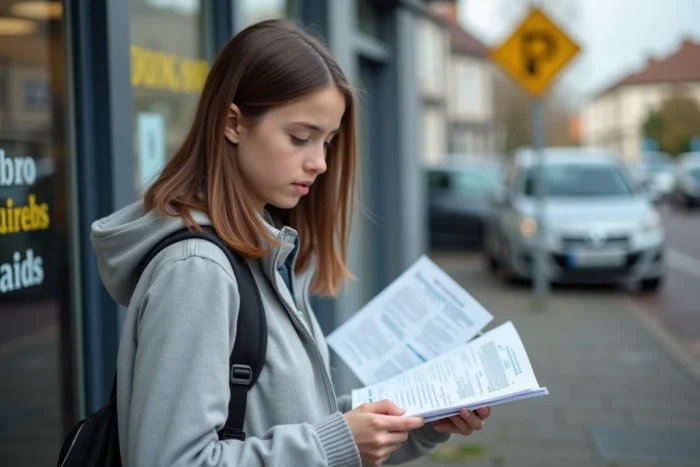
Accompanied driving at 15 and AM license: the two pathways open before 17
For those who want to get behind the wheel as soon as possible, accompanied driving remains the most structured option. Registration is possible from 15 years old, with a precise timeline.
Early learning of driving (AAC)
AAC first requires initial training in a driving school (code courses and a minimum number of driving lessons). Once this training is validated, the candidate enters a phase of accompanied driving for at least one year, during which they must cover a significant number of kilometers with a supervisor who has held a B license for at least five years.
The advantage of this pathway is not limited to the experience gained. Candidates from AAC benefit from a reduced probationary period of two years instead of three, and the success rates for the practical exam are generally higher than those of the classic pathway.
The AM license for two-wheelers from 14 years
The AM license (formerly BSR) allows the driving of a moped or a light quadricycle from the age of 14. It is obtained after a few hours of training in a driving school or an accredited association, without a strict exam. This option does not replace the B license, but it offers a first level of mobility well before 17 years old.
- The AM license does not include a separate theoretical test: the training includes a theoretical part and a practical part supervised by an instructor.
- It applies to vehicles with a cylinder capacity not exceeding 50 cm³ (or equivalent electric) and with a limited maximum speed.
- The training is accessible from 14 years old, making it the first possible step for a young person wishing to travel alone.
NEPH number and registration on ANTS: the administrative process to anticipate
Regardless of the chosen pathway (classic, AAC, independent candidate), the NEPH number is the mandatory prerequisite for any registration for the tests. This harmonized prefectural registration number is obtained free of charge on the ANTS website.
The driving school often handles this process, but an independent candidate can do it themselves. The necessary documents are as follows:
- A valid identity document (national identity card or passport).
- A proof of residence less than six months old.
- A digital identity photo that complies with current standards (e-photo or approved photobooth).
- For those under 18, a census certificate and written consent from the legal representative.
The processing time varies, but it generally takes a few weeks. Starting this process as early as 16 years old, or even a little earlier with the consent of the legal representative, avoids wasting time once the code is obtained.

Insurance and financial aid for young drivers
Obtaining a license at 17 raises the question of car insurance. Young drivers face a insurance surcharge during the first few years. For candidates coming from accompanied driving, this surcharge is reduced from the first year, which constitutes a tangible financial advantage in addition to the shortened probationary period.
Regarding training financing, several schemes exist for those aged 16-25. Some local authorities offer driving license assistance, sometimes conditioned on civic engagement or job-seeking status. The one-euro-per-day license scheme, available from 15 years old within the framework of AAC, allows for spreading the training costs through a zero-interest loan.
The reform lowering the driving license age to 17 explicitly aimed to promote the autonomy and access to employment for young people, as the government specified during the announcement in June 2023. For a 16-year-old candidate planning their path, combining early code, AAC, and financial aid allows for obtaining the B license as soon as 17 years old under the best conditions.
The optimal timeline for a 16-year-old is a few months: ANTS registration and code testing as soon as 16 years old, practical training in parallel or just after, then presenting for the driving exam on their 17th birthday. Each anticipated step reduces the final waiting time, especially in departments where practical exam slots sometimes require several weeks of waiting.