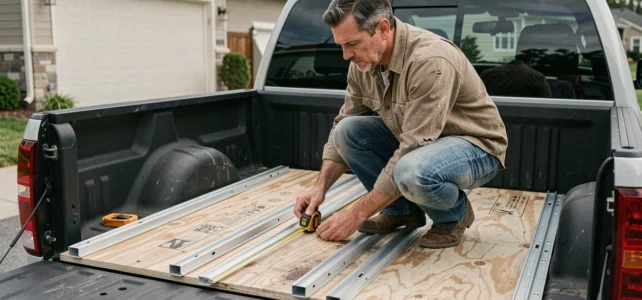
Designing a sliding platform for a pickup raises a question rarely asked upfront: what load must the system support while in motion, and not just when stationary? The distinction between static load and dynamic load radically changes the choice of materials, the type of rails, and the method of attachment. This article measures the gaps between the main DIY approaches to identify the one that corresponds to real use of a truck bed.
Static load vs dynamic load: the parameter that conditions the entire project
A platform can withstand a high weight when the vehicle is stationary. The dynamic capacity, that is, while in motion and especially off-road, is significantly lower. Recent guides on truck bed slide systems emphasize this point: the dynamic load is what matters for mobile use.
Ignoring this distinction leads to oversizing the platform (too heavy, it reduces the remaining payload) or undersizing the rails (progressive deformation, play in the slides). Therefore, before choosing between wood, aluminum, or polyethylene, it is essential to define what the platform will carry while in motion, not what it will hold parked in the driveway.
| Criterion | Wood platform (plywood) | HD polyethylene 1000 platform | Aluminum platform |
|---|---|---|---|
| Weight of the platform (for a standard truck bed) | Medium to high | Low | Low to medium |
| Dynamic load resistance | Acceptable if reinforced | Limited to light loads | High |
| Friction coefficient without rails | High (requires rails) | Very low (slides on the truck bed) | Medium (requires rails) |
| Moisture resistance | Low without treatment | Excellent | Good |
| Material cost | Low | Medium (possible recovery) | High |
| Required tools | Saw, drill, screwdriver | Jigsaw, cutter | Metal saw, drill, riveter |
This table shows that HD polyethylene 1000 allows for the absence of rails due to its low friction coefficient. However, its resistance to dynamic load confines it to light daily uses, not for transporting heavy equipment on trails.
A detailed guide on building a homemade sliding pickup platform allows you to visualize the concrete assembly steps for each type of material.
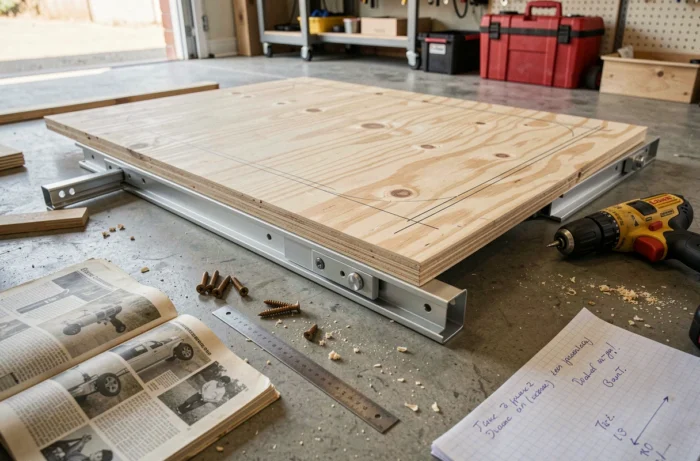
Attachment of the sliding platform: drilling the truck bed or reversible mounting
The method of attaching the rails divides DIY enthusiasts into two camps. Drilling through the truck bed floor offers the strongest attachment but poses a recurring problem: the risk of water infiltration and pitting corrosion.
Non-drilling mounts are gaining ground. Some users attach the rails to existing anchor points in the truck bed or use strap and bracket systems tightened on the edges. This approach is quicker to install and completely reversible, preserving the resale value of the vehicle.
When drilling remains the best option
For a platform intended to carry significant loads while in motion, through-bolting remains more reliable. The key is sealing: each hole must receive a silicone seal or a watertight rivet, followed by a wide washer on the underside. Without this precaution, stagnant water under the truck bed can attack the metal within a few months.
Reversible mounting on anchor points
On most recent pickups, the truck bed incorporates tie-down rings or T-rails. Attaching the slides to these points avoids any drilling and simplifies complete disassembly in a few minutes. The downside: the position of the anchor points sometimes imposes an unsuitable rail spacing, which can generate lateral play.
Hard-top and truck bed cover compatibility: available height changes everything
Competitors rarely address this constraint, yet it is crucial. A sliding platform designed for an open truck bed will not necessarily work under a hard-top or tonneau cover. The usable height under the truck bed cover dictates the maximum thickness of the platform and rails.
With a rigid hard-top, the vertical space available above the platform determines what can be stored there. A system of classic roller rails consumes several centimeters of height. Polyethylene sliding directly on the truck bed, without rails, offers a clear advantage here: the total thickness of the system is limited to that of the plate.
- Measure the height between the truck bed floor and the lowest point of the cover (often at the hinges or the support strut)
- Subtract the thickness of the platform and rails to obtain the actual usable loading height
- Check that the platform, once extended in the open position, does not hit the tailgate locking mechanism or the seals of the hard-top
If you plan to install a camping cell on the truck bed, the constraint is even stronger. The interior space of the cell (bed, storage, heating) directly depends on the space that the sliding platform occupies underneath. Thinking of the platform and the cell as a set avoids having to start all over again.
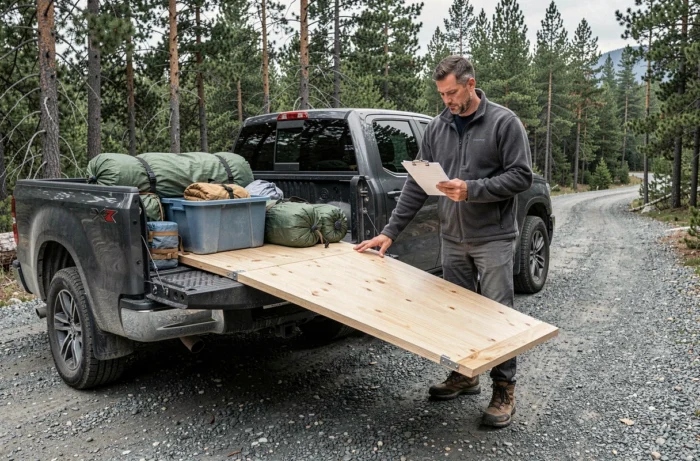
Sizing the sliding rails: truck bed length and usable stroke
On a pickup truck bed, it is not the load that determines the type of slide, but the length. The usable stroke of the platform (the distance it can extend from the truck bed) directly depends on the length of the rails and their type of deployment.
- Simple extension rails allow the platform to extend about half its length, sufficient to access the back of the load
- Full extension (or telescopic) rails allow the platform to extend its entire length, but they are heavier and more expensive
- Over-extension rails exceed the length of the platform, useful for deep single cab truck beds, but the overhang increases the stress on the attachments
Measure the truck bed from the bottom to the closed tailgate before ordering rails to avoid unpleasant surprises. On a double cab, the truck bed generally measures less than on a single cab, which reduces the need for over-extension but also limits the storage volume.
A well-sized platform does not extend beyond the closed position, slides without forcing, and does not tip when pulled. To prevent tipping, the most common solution is to extend the rails beyond the tailgate or to add an anti-tipping stop fixed to the bottom of the truck bed. This detail, often overlooked during design, makes the difference between a reliable system and a platform that pivots as soon as the extended end is loaded.
The choice between these configurations depends on actual use. For heavy construction equipment, bolted telescopic rails remain the safest combination. For recreational setups with light loading, a polyethylene plate guided by the wheel wells and two side boxes is sufficient, without any rails or permanent attachment.