
An ecological lifestyle is not just a list of domestic gestures. It is based on an understanding of the link between natural ecosystems and human behaviors: how a forest regulates carbon, how a living soil filters water, how an urban green space affects the mental health of a neighborhood. Starting from these mechanisms allows for sustainable choices based on facts, not guilt.
Natural regulation of carbon and greenhouse gas emissions
Before discussing daily actions, it is essential to understand a basic mechanism. Forests, wetlands, and soils capture a significant portion of greenhouse gas emissions produced by human activities. This process, known as carbon sequestration, operates continuously as long as these environments remain intact.
When a forest is fragmented or soil is artificialized, this capturing capacity decreases. Therefore, the carbon footprint of an area depends not only on what its inhabitants consume but also on the state of the natural resources surrounding them.
This logic explains why the European regulation on nature restoration, which came into effect in 2024, requires member states to monitor urban green spaces and tree cover. The national restoration plans currently being developed reflect an institutional awareness: protecting nature is not an optional extra; it is a direct lever for reducing environmental impact. Several local and associative initiatives document these links between nature and civic engagement, as can be seen on https://www.faites-de-la-nature.fr/, which lists participatory events focused on biodiversity.
Benefits of nature on health and sustainable behaviors
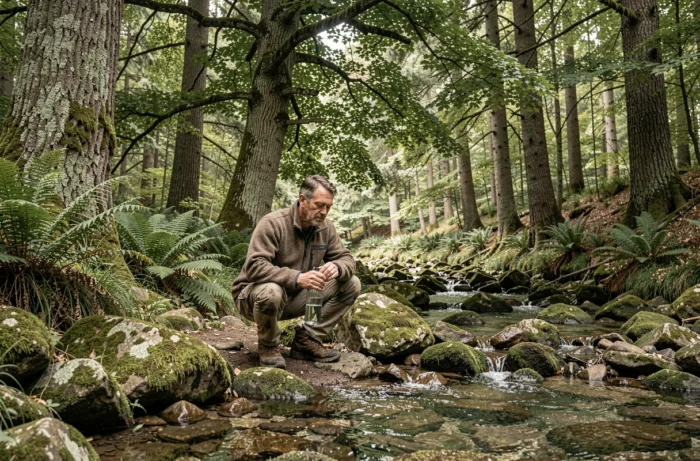
The link between nature and well-being is often presented as self-evident. Available data confirms this, but with a nuance that changes the perspective: the benefits are stronger when the interaction is intentional and rich in biodiversity.
A synthesis reported by EUROPARC in 2026, covering 67 studies, found positive effects in 94% of the analyzed works. The clearest results concerned areas with high plant and animal diversity, not just simple mowed lawns.
This point has direct implications for an ecological lifestyle. Frequenting a diverse forest or a shared garden rich in species not only provides a pleasant moment. It alters the perception of the link between humans and the environment and encourages more sustainable consumption practices.
Nature and mental health: an under-exploited angle
An article published in PLOS Mental Health in 2026 highlights that the British health strategy contains no explicit reference to nature or biodiversity, even though the authors advocate for their integration into prevention and care. This gap illustrates a broader issue: the benefits of nature on mental health are documented but rarely translated into concrete policies.
For individuals, this means that regular access to natural spaces remains an individual effort to organize, due to the lack of systematic public provisions.
Local food and the real carbon footprint of products
Food represents a major area of environmental impact. Food losses and waste account for up to 10% of global greenhouse gas emissions, according to UNEP. The production of plastic related to food packaging exacerbates the problem: about 430 million tons of plastic are produced each year, two-thirds of which quickly become waste.
Reducing one’s food carbon footprint involves concrete choices:
- Favor seasonal and local products, which require less transportation and controlled atmosphere storage
- Limit ultra-processed foods, whose production chain multiplies energy-intensive steps and plastic packaging
- Plan meals to reduce waste, adapting purchased quantities to the actual needs of the household
- Compost organic waste, which returns nutrients to the soil instead of generating methane in landfills
These practices do not require a complete upheaval of daily life. They involve paying attention to the origin and life cycle of consumed products.

Urban green spaces and tree cover: an underestimated lever
The majority of the population lives in urban areas. Access to nature in the city therefore conditions the ability of residents to benefit from the positive effects described above. The European restoration regulation now requires specific monitoring of tree cover in urban areas, which should accelerate greening policies.
In practical terms, a mature tree in the city does not just beautify a street. It reduces ambient temperature by several degrees in summer, filters fine particles, absorbs CO2, and promotes local biodiversity. A tree-lined neighborhood also changes behaviors: residents walk more, use air conditioning less, and develop an attachment to their living environment that slows urban sprawl.
Acting at the local level
Participating in planting programs, joining a shared garden, or supporting associations that preserve peri-urban natural spaces are actions within direct reach. They complement individual gestures to reduce consumption by acting on the collective living environment.
- Engage in a shared garden or a neighborhood greening initiative
- Support local policies for soil de-sealing
- Encourage ecological corridors between green spaces, even on a small scale (hedges, planters, green roofs)
An ecological lifestyle relies as much on the protection of nearby ecosystems as on consumption choices. The two mutually reinforce each other: a preserved natural environment facilitates sober behaviors, and sober behaviors preserve the environment. The European nature restoration regulation, data on the benefits of biodiversity, and the realities of food waste converge towards the same conclusion: nature is not a backdrop; it is an infrastructure upon which the viability of everything else depends.