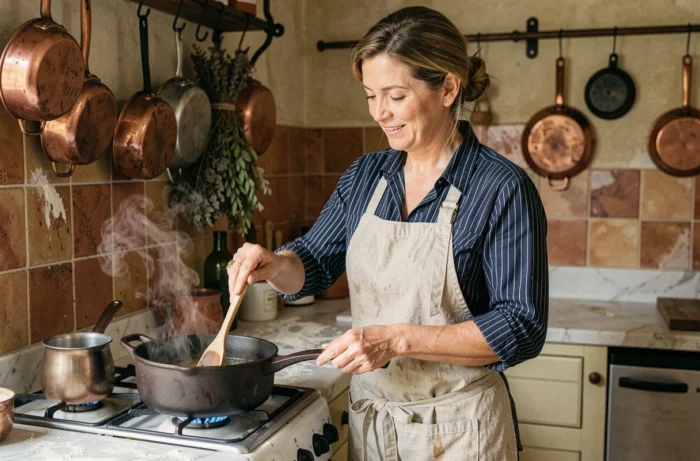
French home cooking is based on a technical foundation that most mainstream articles overlook: the management of stocks, the mastery of emulsions, and the thoughtful choice of fats. Reproducing a bistro dish at home does not require professional equipment, but a precise understanding of what happens in the pot.
Stocks and emulsions: the technical foundation that online recipes gloss over
A brown veal stock or a fish fumet radically transforms a dish. The difference between a sauce that “holds” and a diluted jus almost always lies in this base. We recommend preparing stocks in quantity, then reducing and freezing them in portions.
A concentrated homemade stock is a superior substitute for any industrial stock cube. Slow reduction extracts gelatin from bones and fish bones, giving body without the addition of artificial thickening agents. A fish fumet only requires twenty minutes of cooking, unlike a brown stock which demands several hours of simmering.
Emulsions are another blind spot. White roux, beurre manié, egg and cream emulsions: each has a specific use. Roux is suitable for long sauces (béchamel, velouté), while the egg-cream emulsion is added off the heat to prevent the yolk from coagulating. Several traditional French recipes, such as blanquette de veau or poulette, rely entirely on this technique. Without it, the dish loses its characteristic texture.
We observe that many amateur cooks skip the deglazing step after searing meat. Recovering the cooking juices with a splash of white wine or a bit of stock is, however, the basis of a quick and flavorful sauce, without resorting to commercial preparations. On chez-clara.net, the recipes detail these technical gestures with a precision often lacking in general culinary blogs.
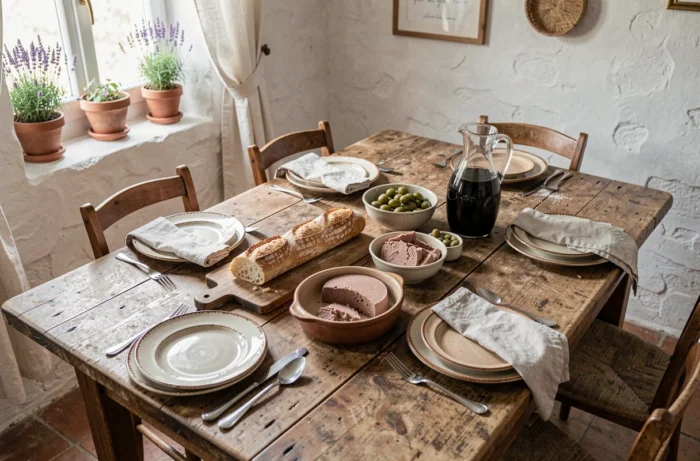
Fats in French cuisine: butter, lard, and oil are not interchangeable
Each fat has a distinct smoke point and flavor profile. Clarified butter can withstand higher temperatures than raw butter, making it suitable for searing. Raw butter is used for finishing or in emulsified sauces where its creamy flavor is desired.
Lard, widely used in Southwestern cuisine, gives sarladaise potatoes and duck confit a texture that olive oil cannot replicate. Dishes from the North and East (choucroute, potée) work better with goose fat or lard than with butter, which burns too quickly in long cooking.
Olive oil finds its place in southern preparations: ratatouille, vegetable tians, aioli. However, using it in a béarnaise sauce is a technical misstep. We recommend keeping at least three fats in the kitchen to cover common uses:
- Unsalted butter for sauces, pastries, and finishing vegetables
- Clarified butter or ghee for high-temperature searing without the risk of burning
- Lard or duck fat for confits, sautéed potatoes, and regional slow cooking
Ingredient origin and the agricultural law of 2026: what changes for the home cook
The emergency law for agricultural protection and sovereignty, enacted on August 18, 2026, modifies the transparency rules regarding the origin of primary ingredients. Private label brands must now prove the French origin of their products. For amateur cooks, this change makes it easier to choose local products at the supermarket.
Specifically, the labels of processed products sold under private labels now clearly indicate the origin of the main raw materials. When you buy lardons, grated cheese, or fresh cream for a quiche lorraine, you can now check if the milk or meat comes from France.
This enhanced traceability aligns with a fundamental requirement of authentic French cuisine: to know the origin of what goes on the plate. The designations (AOP, IGP) remain the most reliable reference for cheese, wine, or certain vegetables like Roscoff onions or Puy lentils. The new regulation complements this system for products that previously escaped geographical labels.
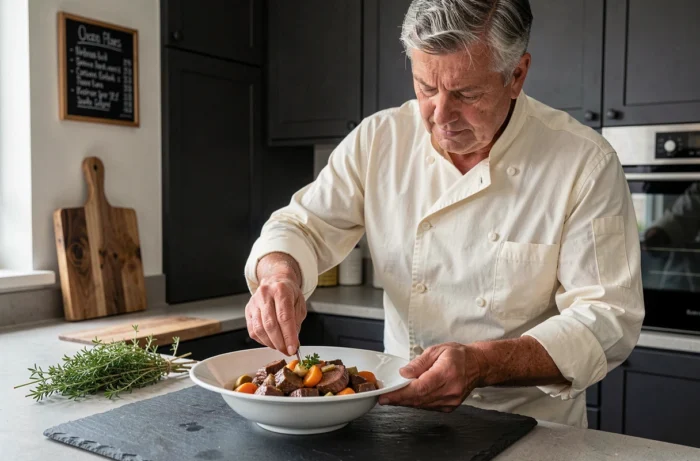
Convivial cooking at home: layout matters as much as the recipe
The 2026 layout trends confirm the transformation of the kitchen into a multifunctional space. The central island serves as both a work surface, a dining table, and a counter for entertaining. Cooking an elaborate French dish in front of guests directly contributes to the conviviality of the meal.
Warm materials (oak, walnut, travertine) and earthy colors enhance the atmosphere of shared meals. Appliances tend to become invisible, hidden behind integrated facades. This choice is not just aesthetic: it frees up space on the work surface, making it easier to prepare long dishes like pot-au-feu or bouillabaisse.
Some concrete adjustments transform daily culinary practice:
- A secondary water point on the island for washing vegetables without leaving the conversation
- A dedicated plating area, separate from the cooking zone, to enhance the presentation of dishes
- Accessible storage for spices and fresh herbs (parsley, chives, tarragon) that are used to finish many French recipes
The meal as a social structure
The conviviality of French cuisine is not limited to taste. The structure of the meal (starter, main course, cheese, dessert) imposes a rhythm that prolongs the time spent at the table. Serving a cheese platter between the main course and dessert, accompanied by a suitable wine, creates a pause that fast meal formats have eliminated.
This sequencing also helps manage the workload in the kitchen: the cold starter can be prepared in advance, the main dish simmers during the aperitif, and the cheese only requires a pass at room temperature. A well-structured French meal is easier to prepare than an improvised menu.
The choice of wine remains the last link. A regional dish almost always benefits from being paired with a wine from the same area: a basque chicken with an Irouléguy, choucroute with an Alsace riesling. This terroir logic is not snobbery; it is based on pairings built over centuries of proximity between vineyards and local culinary traditions.