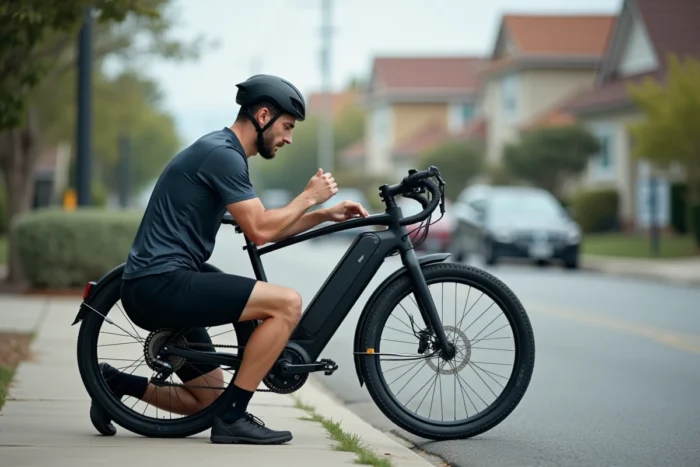
An electric assist bicycle from Decathlon that no longer responds to pedaling remains a functional bike, but much heavier to maneuver. The assistance failure can come from the motor, the battery, the controller, the pedal sensor, or simply a faulty charger. Before taking the bike to the workshop, a methodical diagnosis often helps isolate the cause and sometimes resolve the issue without specialized tools.
Charger and connectivity: the first reflex before blaming the battery
A significant portion of assistance failures on Decathlon e-bikes does not originate from the battery itself. The charger or the connectivity is often to blame, and the symptoms perfectly mimic a dead battery: fixed or off light, refusal to start, gauge stuck at zero.
The right reflex is to test the charger before any other intervention. If a multimeter is available, measuring the output voltage of the charger ensures it delivers the nominal voltage. Without a multimeter, trying the charger on another compatible battery (a friend, a neighbor, a store) confirms or rules out the hypothesis. A charger whose light never turns green, or remains off upon connection, should be replaced.
The connectors between the battery and the frame also deserve a visual inspection. On Elops or Riverside models, the battery fits into a housing where the pins can oxidize or accumulate dust. A gentle cleaning with a dry cloth, sometimes a light application of contact cleaner on the pins, is enough to restore the connection.
Several users share this type of feedback on a forum on Decathlon electric bike failures, which helps pinpoint the problem before heading to the workshop.
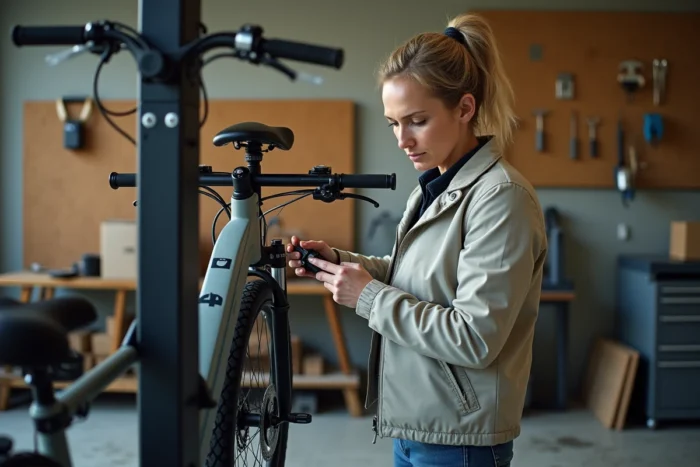
Faulty pedal sensor: a common failure on Decathlon e-bikes
The pedal sensor is a discreet component located near the crankset, which detects the rotation of the cranks and controls the activation of the assistance. When it fails, the motor no longer receives the pedaling information and remains silent, even if the battery and controller are functioning normally.
Typical signs of a faulty sensor:
- The assistance activates intermittently, sometimes after several pedal strokes, sometimes not at all
- The control screen displays the assistance levels correctly, the battery is charged, but the motor does not respond to pedaling
- The assistance works only by pushing the bike by hand (on models equipped with a starting aid), confirming that the motor is operational
On Rockrider and Riverside ranges, the sensor often appears as a magnetic disk and a detector fixed to the frame. A misalignment of just a few millimeters between the magnet and the sensor can be enough to cut the signal. Checking the alignment and tightening is a simple task, doable with an Allen key.
If the sensor is indeed defective, its replacement remains one of the least expensive repairs on an e-bike. The part is generally available through Decathlon’s customer service or on compatible spare parts platforms.
Error codes and reset according to the Decathlon bike model
Decathlon e-bikes display error codes on the control screen when the system detects an anomaly. These codes vary greatly depending on the bike family: an Elops 920 E Connect does not use the same references as a Rockrider E-ST 900 or a B’twin LD 940 E.
Decathlon now publishes customer service sheets by model on its support site, with tables of codes and associated troubleshooting tutorials. Before any visit to the workshop, noting the displayed code and searching for it on the relevant model sheet saves time. Some codes simply indicate a temporary motor overheating or a communication fault between the controller and the screen, resolved by a reset.
Procedure for resetting the electronic system
The basic reset follows a similar protocol on most models:
- Turn off the system via the control screen, then remove the battery from the frame
- Wait about thirty seconds to allow the controller’s capacitors to discharge
- Reinsert the battery, check that the locking is correct, then turn it back on
- If the error code persists after this operation, the problem requires a diagnosis in the workshop
This procedure resolves some software bugs, especially after an interrupted firmware update or a sudden system shutdown.

Spare parts for older Decathlon e-bikes: availability and alternatives
For recent models, Decathlon ensures the availability of parts (batteries, controllers, sensors) through its customer service network and support site. The situation becomes complicated for older generation e-bikes, where some components are no longer listed in the catalog.
When a battery is no longer available new, refurbishment by a third-party specialist is a concrete alternative. The principle involves replacing the worn cells inside the original casing, restoring capacity without altering compatibility with the bike’s system.
For sensors or controllers that are hard to find, some independent workshops specializing in e-bikes sometimes have stocks of compatible parts or adaptation solutions. Checking the availability of parts before starting a repair avoids immobilizing the bike for several weeks while waiting for a component.
The diagnostic in Decathlon’s workshop remains free for certain models under warranty. For others, a paid diagnosis at least allows you to know precisely which part is faulty and to decide between repair, refurbishment, or bike replacement.