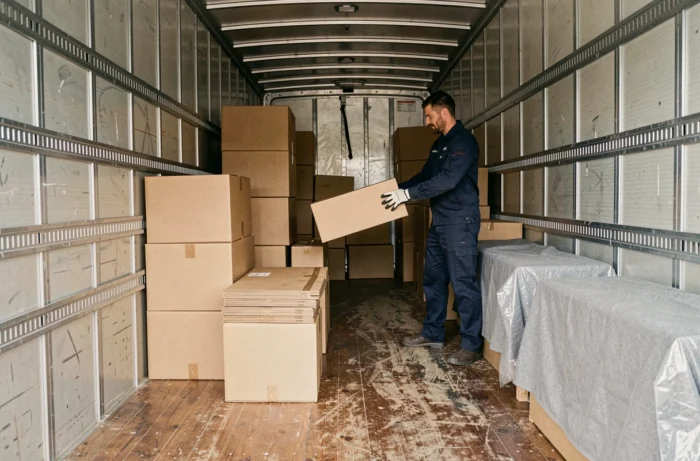
A three-room apartment fits in a 15m3 truck, provided you load it in the right order. The problem is not the total available volume, but how you occupy it. A poorly planned load can easily leave a quarter of the space unused, necessitating a second trip or leaving items on the sidewalk.
Side balancing in a 15m3 truck: a often overlooked step
Loading heavy items first, at the back of the truck, is a good instinct. It’s not enough. The left-right weight distribution is as crucial as the front-back order.
Concentrating the washing machine, refrigerator, and dishwasher on the same side destabilizes the vehicle. In turns or during hard braking, a fully loaded 15m3 truck reacts poorly if the mass tilts to one side. Place the heaviest items closest to the central axis of the floor, then alternate: a heavy piece of furniture on the left, the next on the right.
This lateral balancing logic also changes the stability of stacks of boxes. When the base is asymmetrical, stacked boxes slide during transit, even when strapped. To detail the maximum capacity of a 15m3 truck and the items that can fit inside, the services offered by Detectis Immo provide a useful summary.
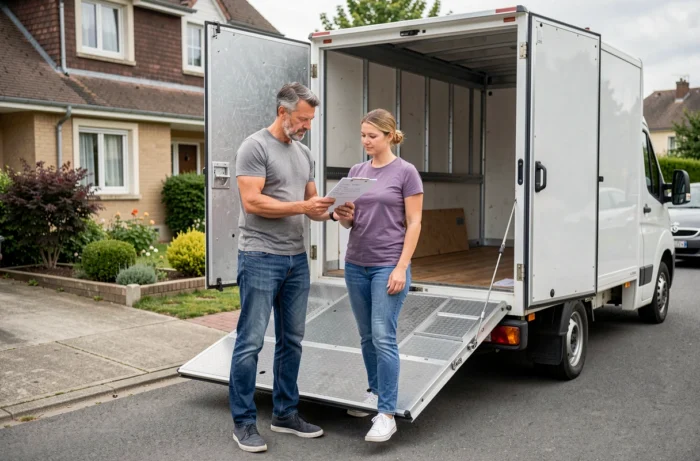
Strapping row by row: the method that prevents breakage during transport
Many people load everything, then strap it down once the truck is full. This is the most common method, and it also causes the most damage.
Securing each row before moving on to the next significantly limits internal movement. Load the first section of about one meter deep, tighten a vertical strap or protective blanket, then tackle the next row.
Effect on breakage and stability
A box of dishes leaning against an unstrapped sofa will shift at the first roundabout. With section strapping, each block remains independent. Feedback varies on this point, but it is regularly observed that there is less breakage when the load is segmented into three or four successive sections rather than strapped as a block at the end.
For ratchet straps, check the tension after each row. A strap placed without tension is useless: it must press the items against the wall or against each other, without crushing fragile boxes.
Authorized total weight and actual volume: two limits not to be confused
A truck advertised as 15m3 refers to the box volume. But the limiting factor is often the weight, not the volume. On a utility vehicle of this size, the maximum authorized weight (PTAC) generally allows a payload between one ton and one and a half tons depending on the model. A move with a lot of books, appliances, or dishes reaches this limit well before filling the available space.
We make the classic mistake of reasoning solely in cubic meters. We think: “there’s still room up high, we can stack more.” Except the vehicle is already at its weight limit. Driving overloaded exposes you to a fine, but more importantly, to degraded braking and accelerated wear of tires and suspensions.
How to estimate your load before the big day
- Mental weigh each heavy item: a standard refrigerator weighs between 60 and 80 kg, a washing machine between 50 and 70 kg, a full box of books easily exceeds 25 kg
- Count the number of heavy boxes (books, dishes, tools) and multiply by their average weight to get a global estimate
- Check the payload indicated on the registration document of the rental vehicle (line F2 minus line G1) before starting to load
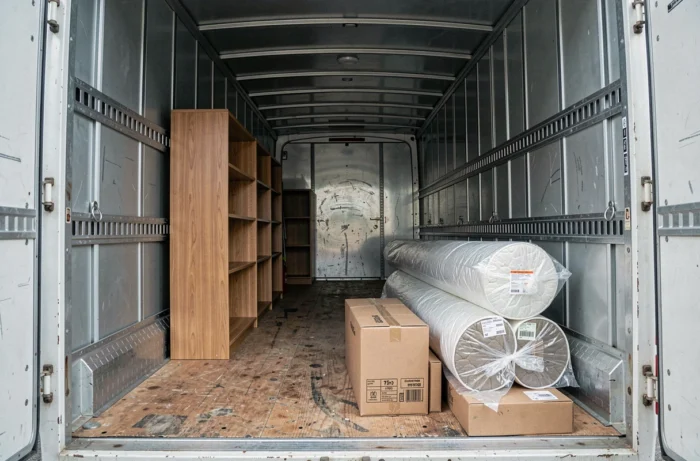
Loading order of a moving truck: the operational sequence
You don’t load a 15m3 like you fill a car trunk. The sequence starts with disassembled furniture, placed vertically against the walls at the back. Bed bases, table tops, wardrobe doors: everything flat and rigid forms the first layer along the walls.
Next come the heavy non-dismantlable furniture. Sofa upright if it fits in height, appliances secured in the center. Fill the empty spaces between the large pieces of furniture with medium boxes.
The top layer and fragile items
The lightest boxes (clothes, linens, duvets) come last and serve as a cushioning layer. Finish with miscellaneous items: plants, floor lamps, vacuum cleaner.
- Never place a heavy box on a light box: the box underneath crushes and the contents deform
- Slide blankets or throws between wooden furniture to avoid contact scratches
- Keep an access passage to the back if you need to unload in multiple stages upon arrival
- Place immediate necessities (toolbox, chargers, overnight items) last, near the door
A well-loaded 15m3 truck leaves almost no visible empty space. Every gap between two pieces of furniture accommodates a box, a cushion, or a soft bag. It is the absence of voids that prevents items from moving during transit, as much as the straps.
The difference between an amateur load and a mastered load does not lie in the chosen vehicle. It lies in these three reflexes: laterally balance, strap by row, and monitor weight as much as volume.