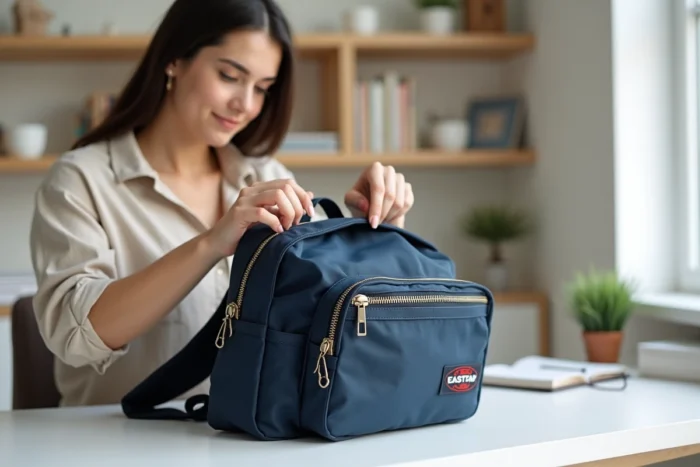
The zipper is the first element to inspect on a suspicious Eastpak bag. Not the logo, not the label: the pull tab. The most common counterfeits consistently fail on this component because the cost of an authentic YKK zipper represents a significant portion of the manufacturing price that a counterfeit workshop cannot absorb.
YKK Zippers and Hardware: The Material Test of a Real Eastpak
Eastpak exclusively uses zippers made by YKK, the world’s leading manufacturer. On an authentic bag, the “YKK” logo is engraved (not printed) on the back of each slider. The engraving is clear, slightly raised, with even edges.
On a counterfeit, there are three scenarios: the YKK logo is absent, it is replaced by a generic marking, or it is present but made with ink printing that fades with friction. We also observe sliders where the letters are engraved irregularly, with visible smudges to the naked eye.
The mechanical function is as important as the marking. A YKK zipper mounted on an Eastpak glides smoothly, with consistent resistance along its entire length. If the slider skips, jams, or requires lateral pressure to move, the bag is not authentic. This check, which can be done in a few seconds on the Stylissima site to authenticate Eastpak, remains the most reliable criterion even before examining the rest of the bag.
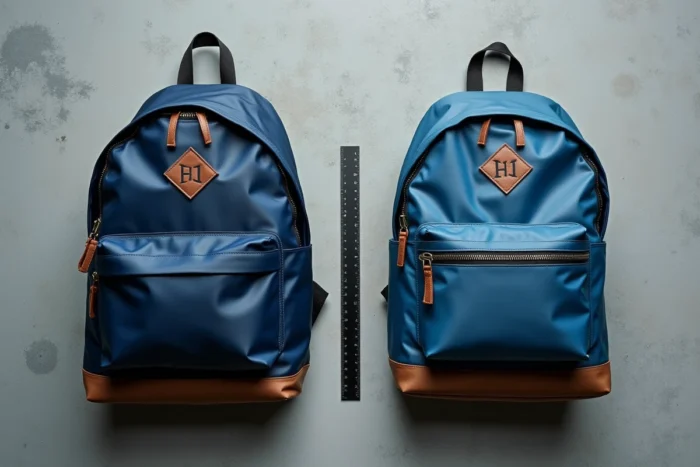
Eastpak Logo and Interior Label: The Details That Give Away a Counterfeit
The exterior logo embroidered on the front pocket of the bag has specific characteristics. The arrow pointing to the left (when viewed from the front) is the most copied marker, but rarely reproduced correctly.
- The tip of the arrow must be symmetrical, with an identical angle on both sides. A common counterfeit shows a flattened or asymmetrical tip.
- The lettering “EASTPAK” is embroidered in white thread on a black background with regular spacing between each letter. Irregular spacing or fraying thread indicates unauthorized manufacturing.
- The outline of the logo is neatly stitched, with no loose threads. Counterfeits often leave visible loose threads on the back of the patch.
The interior label deserves equal attention. On an authentic Eastpak, it mentions the country of manufacture, a model number, and the textile composition. The typography is consistent and the text perfectly centered on the label. A different font between two lines of text, uneven alignment, or a spelling mistake are signals of a counterfeit.
Eastpak Warranty and Sales Channels: Filter Before Purchase
The 30-year warranty offered by Eastpak is a marker of authenticity that counterfeiters cannot replicate. This warranty covers manufacturing and material defects. It is activated via the brand’s official website with the purchase receipt.
A seller who does not mention this warranty, or who replaces it with a vague “satisfaction guarantee” without a specific duration, is likely selling a copy. We recommend systematically checking the warranty policy before finalizing a purchase, especially on resale platforms.
Warning Signals on Online Sales Sites
Fake Eastpak sites are multiplying, often with domain names close to the official site. Several elements allow for quick identification:
- The absence of complete legal mentions (company name, address, SIRET number for a French seller) is a first signal.
- An abnormally low price compared to the usual rate should raise alarms. Promotions exceeding half the catalog price do not exist on official channels.
- The absence of a clearly visible withdrawal button on the sales site constitutes a regulatory failure. In France, the right of withdrawal must be accessible without ambiguity on any online sales site, and its absence signals an unreliable, if not fraudulent, site.
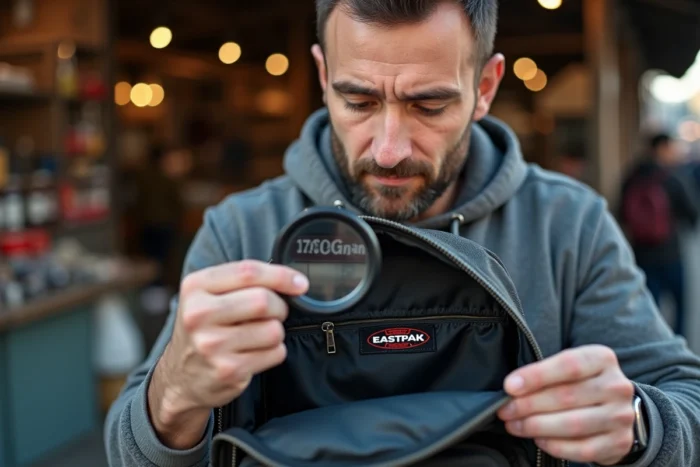
Cordura Fabric Quality and Stitching: The Tactile Examination of an Eastpak Bag
The majority of Eastpak bags are made from Cordura fabric, a high-tenacity nylon textile recognizable by its tight weave and relative rigidity. To the touch, the fabric resists deformation: if you pinch the fabric between two fingers, it immediately returns to its original shape.
Counterfeits use standard polyester, which is softer and thinner. The difference is noticeable as soon as you pick it up. The fabric of a copy wrinkles easily, lacks structure, and sometimes has a slightly shiny appearance that authentic Cordura does not have.
Stitching and Interior Finishes
The stitching on an authentic Eastpak is double in tension areas (straps, bottom of the bag, junction of the front pocket). Each stitch is straight, even, with no skipped stitches. On counterfeits, single stitching often replaces double stitching, and loose threads appear inside the bag after the first uses.
The interior lining of a real Eastpak is smooth, without folds or bubbles. On a copy, the lining is often glued rather than sewn, leading to quick peeling.
All of these checks, from the YKK zipper to the quality of the Cordura, take less than two minutes. A bag that fails on even one of these criteria does not deserve the benefit of the doubt: counterfeiters rarely replicate all the details at once, and it is precisely this accumulation of consistent finishes that distinguishes an authentic Eastpak from a copy.