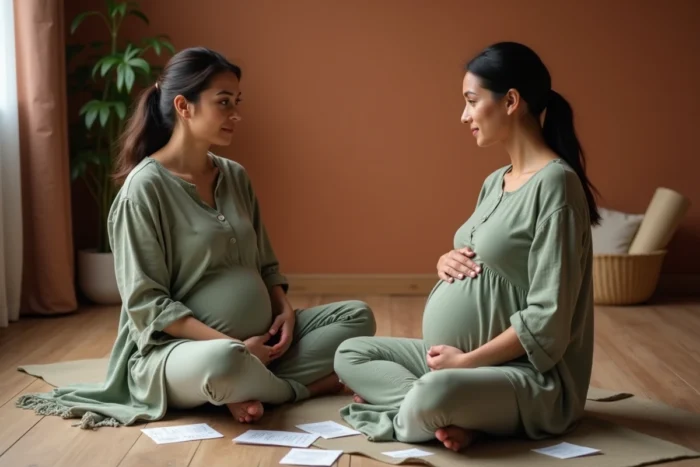
Accompanying parents around the birth without making a diagnosis or prescribing treatment: this is the daily life of a doula. This non-medical support profession attracts more and more people each year, whether they are transitioning careers or already active in the perinatal sector. However, unlike a midwife or a pediatric nurse, a doula does not hold a state diploma. This apparent ambiguity actually conceals a structured, demanding training pathway that is increasingly regulated by specialized organizations.
Doula in France: a profession without a state diploma but not without a framework
You may be wondering how to practice a profession that does not have an official diploma? The answer lies in one word: professionalization. In recent years, training organizations and associations like Doulas de France have structured the pathway to the profession with ethical charters, supervision obligations, and rigorous educational programs.
The absence of a state diploma does not mean the absence of rules. Doulas trained in centers recognized by the Doulas de France association commit to respecting a practice charter. This charter clearly delineates the scope of intervention: the doula never replaces a healthcare professional. She provides emotional, informational, and practical support before, during, and after the birth.
This de facto professionalization, without state recognition, aligns with recent directions in the “1000 first days” policy. Public reports emphasize the comprehensive support for parents and non-medical assistance to families, describing missions very similar to those of a doula. Choosing a training and curriculum to become a doula that incorporates these perinatal health prevention issues enhances the credibility of professional practice.

Content of a doula training: what you really learn
A doula curriculum is not limited to reading books about childbirth. Serious programs cover several complementary areas, and it is their integration that makes the difference in practice.
- Physiology of pregnancy and childbirth: understanding the major stages of labor, positions, the hormones involved, without ever crossing into medical diagnosis.
- Listening posture and helping relationship: learning to support without projecting, to inform without guiding. This relational skill occupies a significant part of the curriculum.
- Breastfeeding and postpartum: supporting the first days with the newborn, identifying signs of difficulty (baby blues, isolation), knowing how to refer to competent professionals.
- Legal and ethical framework: limits of the doula’s role, professional secrecy, coordination with midwives, doctors, and maternal and child protection services.
- Self-work and supervision: most training programs require personal work (therapy, support groups) to avoid projections in the support.
This last point often surprises. Why self-work to support a birth? Because perinatality touches on the intimate. A poorly prepared doula emotionally can do more harm than good. Curricula that neglect this aspect produce fragile supporters in complex situations.
In-person or online doula training: concrete selection criteria
The training market has diversified. Today, there are in-person, remote, or hybrid formats. The choice is not just a matter of logistical comfort.
In-person: learning through the body
In-person training, such as that offered by the Galanthis Center, includes role-playing, simulations, and bodywork (massage, positions, breathing). In-person remains the most suitable format for acquiring the support posture. You do not learn to hold the hand of a woman giving birth behind a screen.
Online training: a complement, not a substitute
Some organizations offer theoretical modules remotely. This format works well for anatomy, legal framework, or breastfeeding. However, it cannot replace relational practice. A 100% online curriculum should raise concerns: check if it includes mandatory internships or in-person gatherings.
The duration of training varies significantly. The most comprehensive programs span ten months or more, alternating theory, practice, and work on professional posture. A curriculum that is too short (a few weekends) does not cover all the necessary skills.

After doula training: establishing and practicing daily
Obtaining a training certificate is not enough to fill a schedule with appointments. Establishing oneself as a doula involves creating an independent activity, often under the status of a micro-enterprise.
Joining a professional network like Doulas de France allows one to appear in a directory consulted by expectant parents. This visibility comes at a cost: adherence to the charter, participation in regular supervisions, and commitment to ongoing training. This system functions like an informal quality label.
Post-training specialization is gaining ground. Some doulas choose to train specifically in perinatal grief, supporting premature births, or assisting families in situations of social vulnerability. These additional certificates extend the pathway but open fields of intervention where needs are considerable.
The doula profession is built over time, through the accumulation of hours of supervised support, ongoing training, and anchoring in a network. The first years require patience: the trust of families and healthcare professionals is earned through support after support, not with a certificate alone.