
You are looking for an apartment and come across two listings: one indicates “T1”, the other “T1 bis”. The rent differs, the area does too, but the number of rooms displayed remains the same. Understanding the difference between a T1 and a T1 bis before signing a lease helps avoid unpleasant surprises, both in terms of daily comfort and budget.
T1 bis: a concept absent from the Building Code
Before comparing the layouts and areas, one point needs to be made clear. The T1 bis has no official legal definition. Neither the Building and Housing Code nor any decree creates this category.
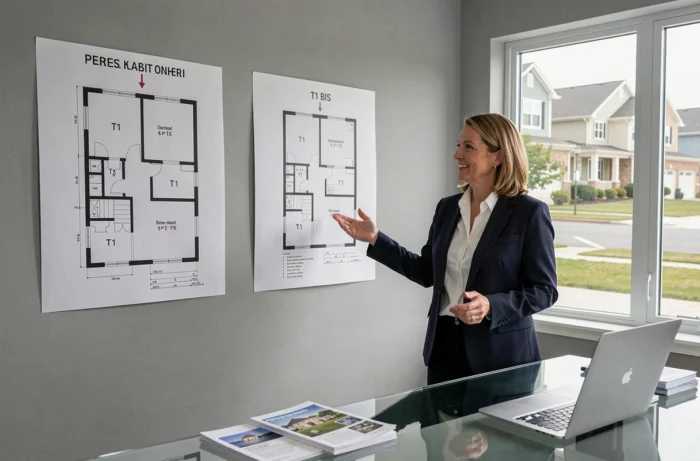
In practice, real estate professionals use the term to refer to a T1 whose layout offers an additional sleeping space. This space can take the form of a nook, a mezzanine, or an alcove. It does not meet the criteria to be classified as a main room (minimum area, ceiling height, window opening to the outside).
To understand what a T1 is according to Immogenius, it is important to remember that the T refers to the number of main rooms excluding the kitchen and bathroom. A T1 therefore has only one living room. The T1 bis also has one, but with a sleeping area that is identifiable and visually separated from the living room.
This lack of legal framework has a direct consequence: a landlord can freely label their property as a T1 bis without any standards preventing them from doing so. Hence the importance of checking the layout and visiting.

Why a T1 bis does not qualify as a T2: concrete criteria
You visit a T1 bis with a small room separated by a low partition. Why does the listing not indicate T2? Because for a space to be counted as a main room, it must meet several cumulative conditions.
- A minimum area (often cited as 9 m²) with a ceiling height of at least 2.20 m.
- A proper partition that isolates the space from the rest of the dwelling (walls, door).
- An opening to the outside, typically a window, ensuring natural light and ventilation.
In a T1 bis, the additional space generally does not meet all of these criteria. A mezzanine does not have its own window. An alcove has neither a door nor a complete partition. The sleeping area exists, but it does not constitute a room in the regulatory sense.
For a tenant, this distinction is not trivial. The housing tax (when it still applies), the cadastral rental value, and some charge calculations take into account the number of declared rooms. A T1 bis remains fiscally a T1.
Living area and rent: what changes between T1 and T1 bis in rental
A classic T1 offers a living room, a separate kitchen (or an integrated kitchenette), and a bathroom. The area generally revolves around compact configurations, suitable for a single person.
The T1 bis, thanks to its additional sleeping space, offers a few more square meters. This difference in area is reflected in the rent. In cities where the rental market is tight, a few extra square meters can represent a significant rent difference for a property that remains legally a T1.
A common trap in listings
Some listings display “T1 bis” for a property whose additional space is limited to a nook of three square meters behind a curtain. Others describe a true T2 as a T1 bis, sometimes to circumvent rent controls in tight areas.
When faced with a listing, always check the layout of the property. Ask for the exact living area mentioned in the lease, not just the one in the listing. The Boutin law requires that the lease indicates the actual living area, and a discrepancy of more than 5% entitles you to a proportional rent reduction.
Choosing between T1 and T1 bis based on your lifestyle
A T1 is suitable for those who only need a functional space to sleep and live. A student, a young professional on the move, or a single person with few belongings will find it adequate.
The T1 bis changes the game as soon as you spend time at home. Being able to separate the sleeping area from the living room, even without a door, alters the perception of space. Hosting a friend without them seeing the bed, working in the main room while the sleeping area remains tidy: these are tangible comfort gains.
Some points to check before signing
- Does the layout of the property match the description in the listing? A T1 bis must offer a clearly defined sleeping area, not just a simple nook.
- Is the living area stated in the lease consistent with what you measured during the visit?
- Is the rent justified by the actual area and layout, or is the term “bis” mainly used to inflate the price?
- In rent-controlled areas, is the property declared T1 or T2 with the local observatory? This determines the applicable reference rent.
A well-designed T1 bis can offer comfort close to that of a T2 for often lower rent. But this advantage only holds if the additional space is real and usable, not just cosmetic in a listing.
The difference between T1 and T1 bis ultimately comes down to a few square meters and a layout that visually separates the sleeping area. No law protects the definition of T1 bis: it is up to the tenant to verify what they are renting, with the plan in hand, the area in the lease, and after a visit.