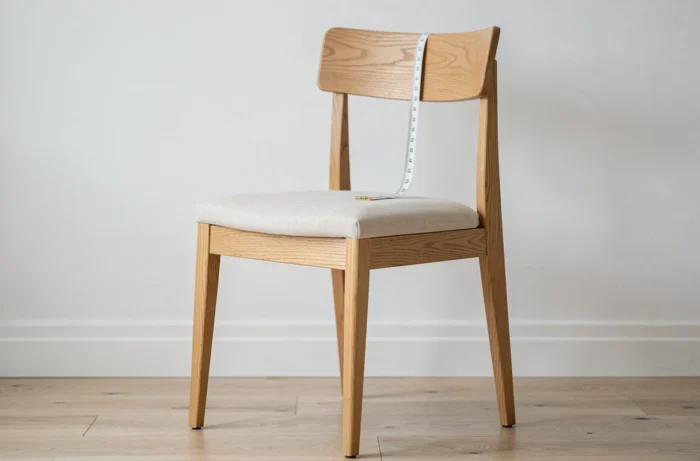
You order a chair online, it arrives, and the seat sticks out from the table or your knees hit the tabletop. The problem rarely comes from the chosen model, but from a measurement that was taken incorrectly or ignored. Before discussing style or material, it is the compatibility between the chair and the table that determines daily comfort.
Gap between seat and tabletop: the reference that avoids mistakes
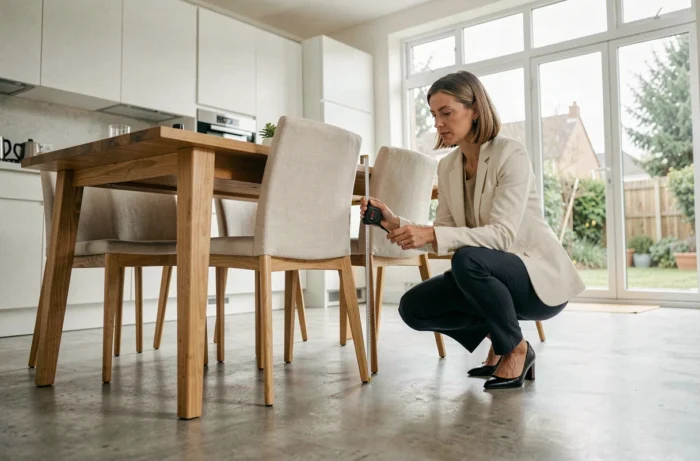
We often talk about seat height without specifying what it should relate to. The isolated number is useless. What matters is the gap between the top of the seat and the underside of the tabletop.
For a classic dining or meeting table, this gap is around 25 to 30 cm. Below this, the thighs become compressed. Above this, the elbows rise too high and the shoulders tense up after a few minutes.
In practice, when measuring a chair, we focus on the total height indicated on the product sheet. This height includes the backrest, which does not inform about the actual position of the pelvis. You need to look for the mention “seat height” and ensure that it corresponds to the standard dimension of a chair suitable for the height of your tabletop.
For a standard table with a tabletop around 75 cm, a seat height between 45 and 48 cm works in most cases. If the table is lower (like a Scandinavian coffee table around 70 cm), the seat height should be lowered proportionally.
Seat depth and posture: what the product sheet doesn’t always say
Seat depth is the most overlooked measurement when buying online. We look at the width, height, sometimes the weight, but rarely the distance between the front edge of the seat and the backrest.
A depth that is too great forces you to slouch to reach the backrest. The lower back loses all support, and the position becomes tiring in less than half an hour. Conversely, a seat that is too short creates pressure under the thighs that cuts off circulation.
The ideal seat depth leaves two to three fingers between the back of the knee and the edge of the chair. For most adults, this corresponds to a depth between 40 and 45 cm. Beyond 50 cm, you move into a relaxed seat, like an armchair, which is not suitable for dining or working at a table.
Special case of office chairs
In a workstation, the European standard EN 1335-1:2020 distinguishes several categories of chairs (types A, B, C) with different adjustment ranges. The issue is no longer a fixed dimension, but the available adjustment range: seat height, depth, lumbar support, armrests.
The regulatory trend in Europe is moving towards requirements for adjustability rather than fixed dimensions. In other words, a good office chair is not the one that has “the right size,” but the one that offers enough adjustment ranges to adapt to the morphology of each user.
Seat width and spacing around the table: the real layout constraints
Seat width determines how many people can sit around a table without getting in each other’s way. Generally, 60 cm of width per guest is planned for proper comfort.
Be careful not to confuse seat width with the overall footprint of the chair. On a model with armrests, the overall footprint can exceed the seat width by 10 to 15 cm on each side. This detail changes everything when arranging a dining room or a meeting space in a company.
- Measure the usable length of your table (removing the legs or unextended leaves), then divide by 60 cm to estimate the realistic number of places.
- Plan for 70 to 80 cm behind each occupied chair to allow someone to stand up or pass without disturbing others.
- In a shared workspace, count at least 80 cm between the edge of the table and the wall to accommodate the chair’s pullback and a passage.
Small spaces: compromises that work
In an apartment where the room is less than 12 m², we often sacrifice seat depth or armrests. Stackable chairs without armrests, with a seat depth around 40 cm, remain the most common compromise. They can be stored away and free up circulation.
Feedback varies on this point, but a bench along a wall combined with chairs opposite can sometimes gain the space of an additional guest without affecting the dimensions of the table.
Child chair height and high chair: distinct references
Standard adult dimensions do not apply to children. For a child aged 3 to 6 years, the seat height is around 25 to 30 cm, with a proportionally reduced depth.
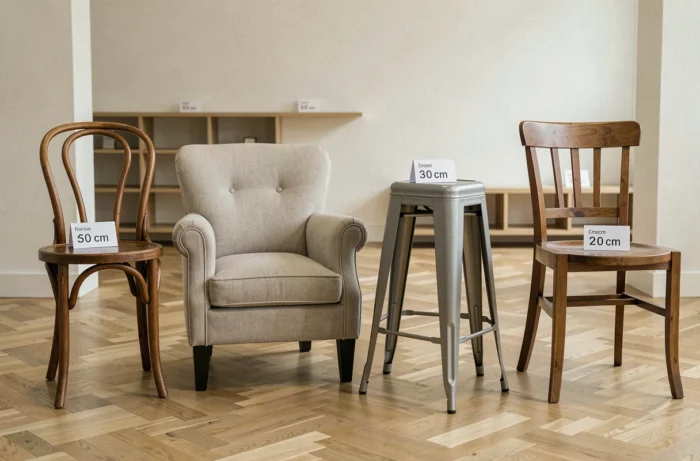
A high chair of the bar or central island type requires a seat height between 60 and 80 cm to adapt to elevated work surfaces. The gap between the seat and the work surface remains the same reference as for a classic table: about 25 to 30 cm.
For school or corporate training spaces, dimensional standards are more regulated. Seat heights are calibrated by body size range, not by age, which avoids approximations.
Summary table of standard dimensions by use
| Use | Seat Height | Seat Depth | Usable Width per Place |
|---|---|---|---|
| Dining / Meeting Table | 45 – 48 cm | 40 – 45 cm | 60 cm |
| Office (adjustable chair) | 40 – 52 cm (adjustment range) | 40 – 50 cm | Variable depending on armrests |
| High Chair (bar / island) | 60 – 80 cm | 35 – 40 cm | 60 cm |
| Child Chair (3-6 years) | 25 – 30 cm | 25 – 30 cm | 35 – 40 cm |
These references cover the majority of domestic and professional configurations. The seat-table gap remains the most reliable verification criterion regardless of the type of chair. Before confirming a purchase, a tape measure and two minutes are enough to avoid a chair that will end up in the garage.